Value-based bidding: how to send predicted customer value to Google, Meta and TikTok




Value-based bidding means sending every conversion to your ad platforms with a value attached, ideally a predicted value, instead of a flat count. Google, Meta and TikTok then optimise toward the visitors most likely to become high-value users, rather than the cheapest sign-ups they can find. The earlier you can send that value, the sooner the bidding improves.
The idea behind this guide is simple: tell the platforms what a visitor is worth before they convert, and they start bidding for customers instead of sign-ups.
Why do ad platforms chase sign-ups?
Ad platforms chase sign-ups because a sign-up is usually the only signal you give them. If every conversion arrives as "1 registration", the algorithm treats every registration as equal and finds you more of whatever is cheapest to get.
That is a reasonable outcome for the platform and a poor one for you. As our Segmentation page puts it, less than 1% of your users drive most of the revenue, and your own data can't tell you which ones until you've already spent the budget finding out. A bidding system that cannot tell those users apart from everyone else will happily buy you thousands of low-value accounts, because they are the easiest to win in the auction.
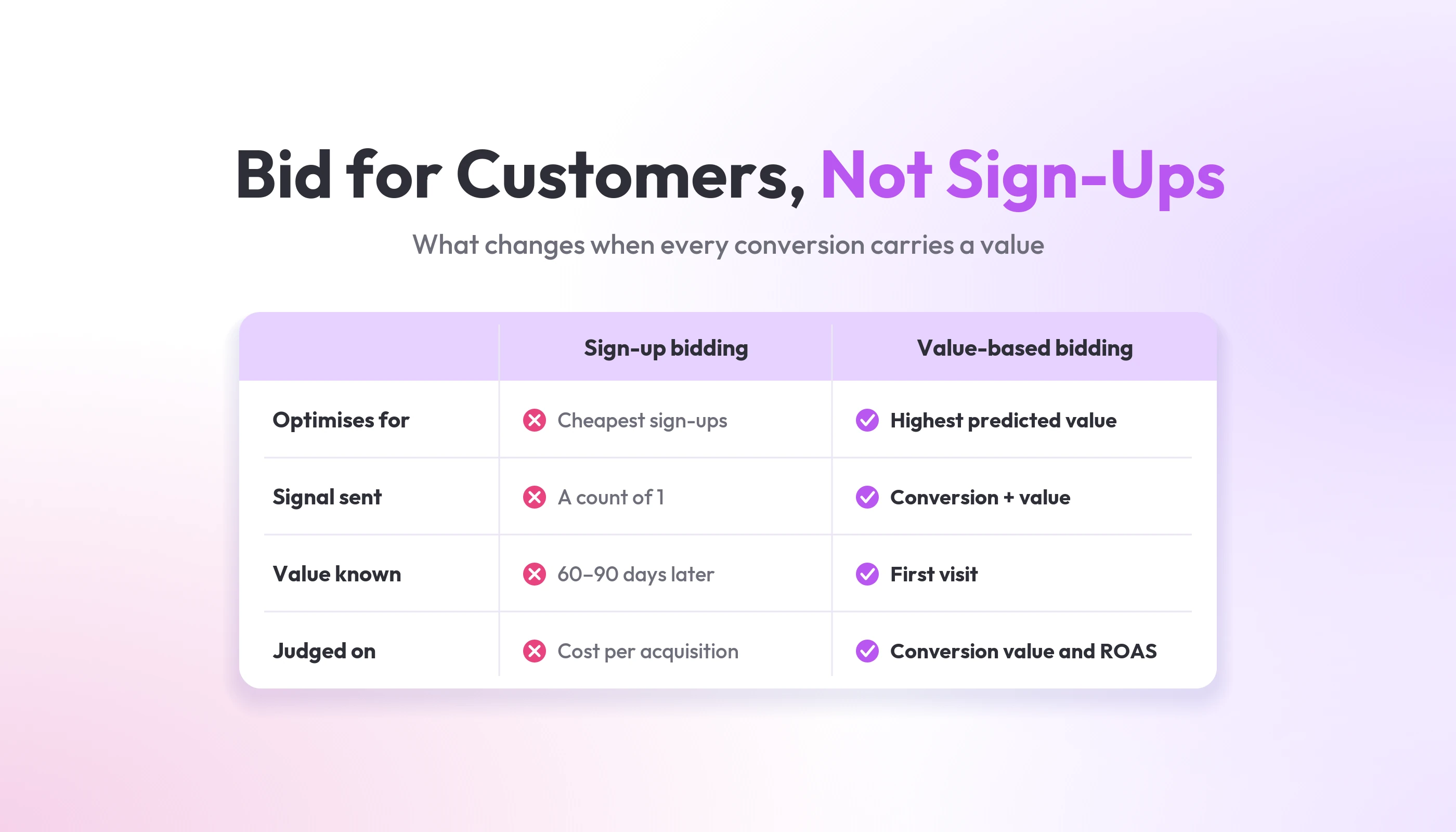
The fix is not a new channel or a new creative. It is giving the bidding algorithm better information about which conversions matter. Every major platform already has a bid strategy built for this; most advertisers simply never feed it real values.
What does value-based bidding need from you?
Value-based bidding needs three things from you: values that actually differ between conversions, enough conversions for the algorithm to learn from, and a way to deliver those values quickly and reliably.
Values that differ. Google is explicit that you must report two or more different values to a conversion goal, and that these can be real revenue or proxy values such as a lead score (Google Ads Help). If every conversion carries the same number, there is nothing to optimise toward.
Enough volume. Each platform sets its own floor:
- Google: Target ROAS should have at least 15 conversions in the last 30 days at the conversion tracking level (Google Ads Help).
- TikTok: Value-based Optimization for web becomes available after at least 20 attributed purchase events with value and currency over any 7 consecutive days (TikTok Ads Manager).
- Meta: value bid strategies need value data on your purchase events, and the value field is required for any event used in value optimisation (Meta Conversions API documentation).
Speed and consistency. Google recommends a conversion delay of under 7 days, daily uploads for offline conversions, and warns that long delays can stretch the ramp-up period to several months (Google Ads Help). A value that arrives three months after the click is too late to change who you bid on today.
That last requirement is where most value-based bidding projects stall.
What is the difference between pre-conversion and post-conversion signals?
Post-conversion signals describe what a user did after signing up, such as their first deposit or 90-day revenue. Pre-conversion signals describe what you can know about a visitor before they convert. Post-conversion values are accurate but slow; pre-conversion values are what make value-based bidding work early.
Most teams send post-conversion values, because that is the data they own. The problem is timing. A user's real value usually only becomes clear weeks or months after the click, and lifetime value models typically need 60 to 90 days of behaviour before they say anything useful. By then the campaign that acquired them has already spent its budget.
A predicted value solves the timing problem. Instead of waiting for revenue, you send an estimate of what the conversion is likely to be worth, at the moment it happens. This is what people mean by pLTV bidding: bidding on predicted lifetime value rather than on realised revenue.
The quality of that prediction depends on what you can see at the time of conversion. For a brand-new visitor, your own first-party data is almost empty. This is where outside signals help. For crypto-active audiences, public on-chain activity already describes a visitor's history: how long their wallets have been active, which exchanges and apps they use, and how they behave across platforms. Addressable's high value user identification matches your anonymous traffic on the first visit, then pivots from a single wallet to every other one the same user controls and scores them together, so a predicted value can be attached to the very first conversion event.
These signals indicate likely commercial value, never affordability or ability to spend. Post-conversion data still matters: it is how you check that your predictions were right, and how you improve them over time.
How do you set it up through the Conversions API as a standard event?
At the end of this section you will have a predicted value flowing to each platform, on a conversion event the platform already understands, delivered server-side so it arrives quickly and reliably.
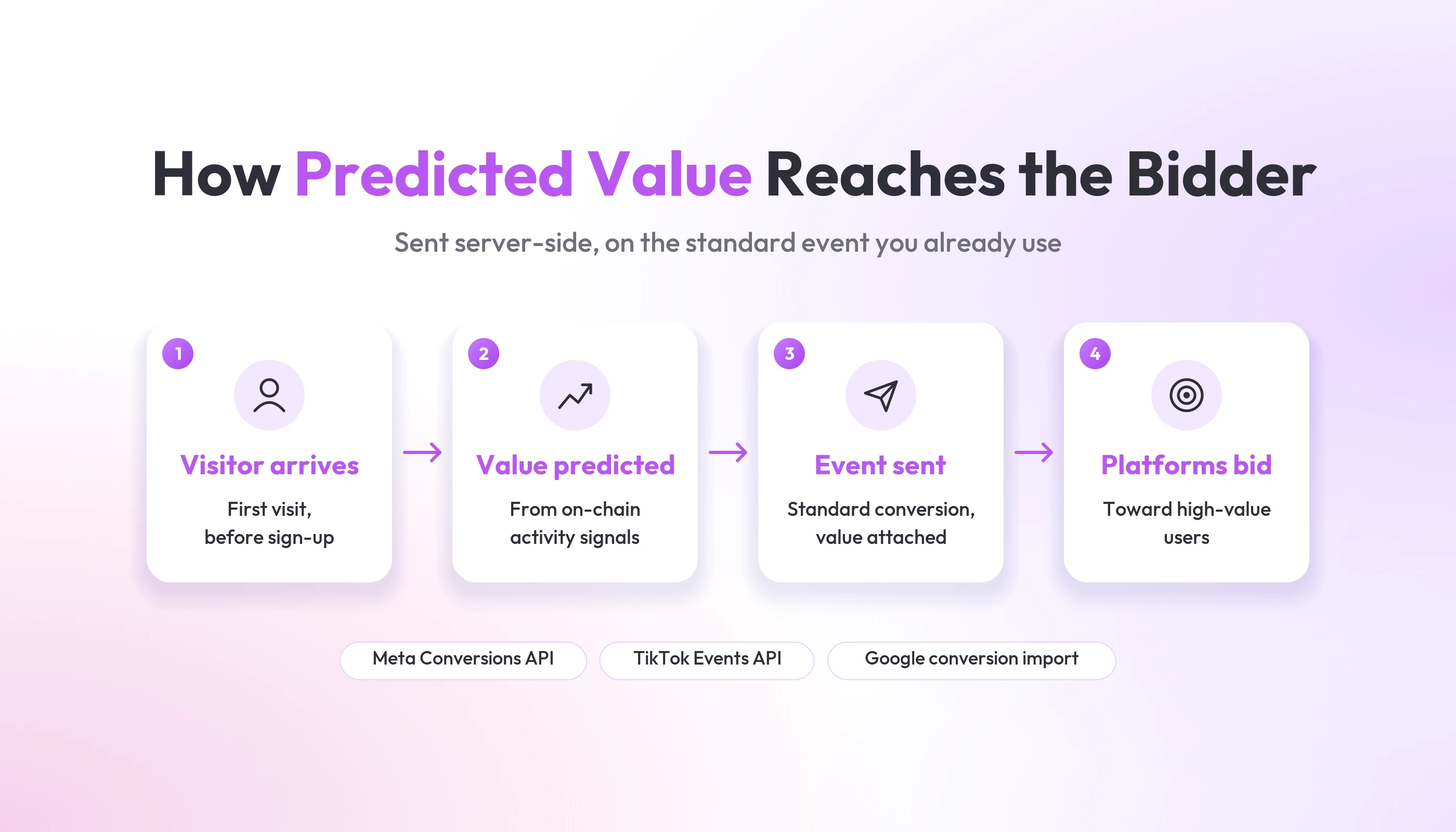
You send predicted value through each platform's server-side conversion connection: the Conversions API on Meta, the Events API on TikTok, and conversion import on Google. You attach the value to a standard conversion event, so you do not need new dashboards or custom reporting on the platform side.
Before you start, check that you have:
- A primary conversion event the platform already optimises for (for example, a registration or first deposit).
- Server-side event delivery set up, or a partner who handles it.
- A source of predicted value for each conversion, available at the time the event fires.
- Agreement internally on which campaigns will test the change.
Steps:
- Pick one conversion stage to bid on. Google recommends choosing a single stage in the journey for bid optimisation and weighing accuracy against delay. An early event with a predicted value often beats a late event with a perfect one.
- Keep the event standard. Send the value on the event the platform already optimises for, rather than inventing a custom event. The bidding system learns faster from an event it already has history on.
- Attach the predicted value to each event. On Meta, the value field (with currency) carries the number used for value optimisation, and Meta's Conversions API (CAPI) also has a dedicated predicted_ltv parameter, which is the natural home for a predicted value (Meta). On TikTok, the value parameter is required for Value-based Optimization (TikTok). On Google, the value sits on the conversion action itself.
- Send events as they happen. Stream events in real time or upload them at least daily. Avoid backfilling large batches of historical values, which Google advises against (Google Ads Help).
- Let values build up before switching strategy. Google recommends uploading values for 3 weeks or 1–2 conversion cycles, whichever is longer, before activating value-based bidding (Google Ads Help).
- Switch on the value strategy. Move the test campaigns to Maximize conversion value or Target ROAS on Google, Highest value or ROAS goal on Meta, and Highest Value or Minimum ROAS on TikTok. If you set a ROAS target, start from your recent actual ROAS rather than an aspirational number.
With Addressable, you tell Google, Meta and TikTok what a visitor is worth before they convert: the predicted value is sent as a standard conversion event, and the platforms start bidding for customers instead of sign-ups. Your team keeps its existing campaigns, events and reporting; only the value on the event changes.
How do you measure it with your own attribution (A/B)?
At the end of this section you will have a clean test design that shows whether value-based bidding produced more value than your current setup, judged by your own numbers rather than the platform's.
Measure value-based bidding with a split test: run your current bid strategy and the value-based strategy side by side on the same campaigns, change nothing else, and compare the value each arm produces using your own attribution.
- Change one thing. The only difference between the two arms should be the bid strategy. Google's guidance is to test one variable at a time and never compare different conversion actions in the same test (Google Ads Help).
- Split traffic evenly. Google recommends a 50/50 split between base and trial arms, with experiment sync turned on.
- Pick a campaign with enough volume. For experiments, Google suggests at least 50 conversions in the last 30 days so both arms have enough data.
- Allow a ramp-up period. Give the trial arm 2 weeks or 1–2 conversion cycles, whichever is longer, and exclude that period from the evaluation.
- Run it for at least 30 days after ramp-up. Google's sample timeline runs the experiment uninterrupted from day 14 to day 44.
- Judge on value, not volume. Compare conversion value and ROAS. Google notes that metrics such as CPA and clicks are incidental in a value-based test and should not decide it.
- Use your own attribution for the verdict. Platform-reported ROAS is useful, but the deciding number should come from your own systems: deposits, revenue or retained users, matched back to each arm.
Expect the value-based arm to buy fewer of the cheapest conversions. That is the point of the test, not a sign it is failing.
What results should you expect?
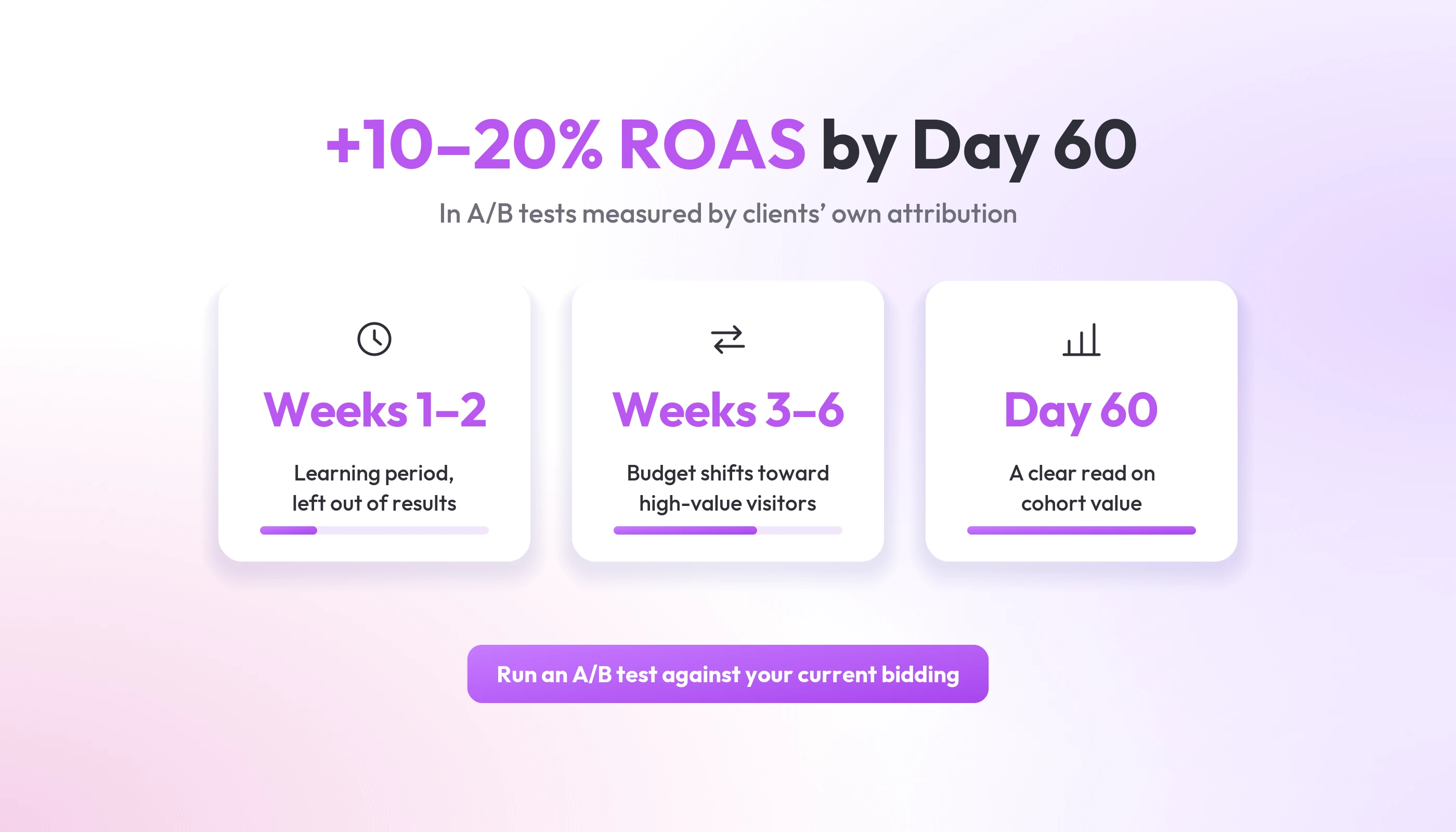
Expect fewer cheap sign-ups, a higher share of valuable users, and a ROAS gain that builds over the first two months rather than appearing in week one. In A/B tests across brands in fintech, apps, e-commerce and gaming, measured by each client's own attribution and integrated via CAPI, Addressable's value-based bidding has delivered a 10–20% ROAS uplift by Day 60.
How the gain arrives matters as much as its size:
- Weeks 1–2: the learning period. Results are noisy and should be excluded from the evaluation.
- Weeks 3–6: the bidding shifts budget toward higher-value visitors. Cost per sign-up may rise while value per sign-up rises faster.
- By Day 60: the cohort acquired under value-based bidding has had time to show its real value, and the comparison with the control arm becomes meaningful.
Three things tend to decide where in that range a campaign lands. The first is how much your users' value really varies: the wider the spread, the more there is to gain. The second is how early the predicted value arrives. The third is test discipline: changing creatives, budgets or targets mid-test makes any result hard to read.
If you want to see who your high-value users are before you change any bidding, start with high value user identification, then use those signals as the value you send.