What is KYT compliance, and where does it stop?



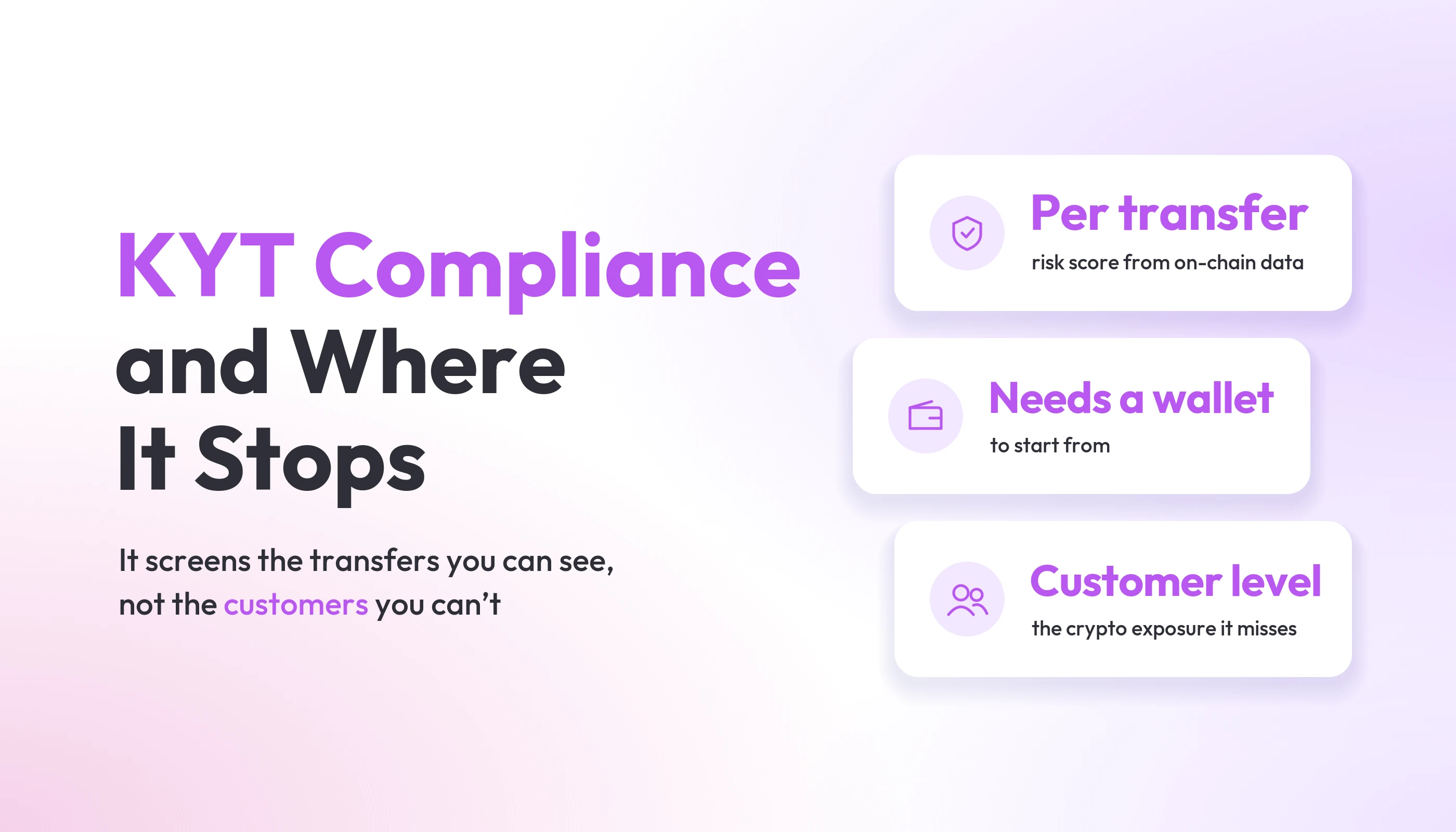
KYT, or Know Your Transaction, is the compliance practice of screening crypto transactions and the wallets behind them for risk. KYT compliance answers one question well: is this transaction risky? It needs a wallet or a transfer to start from, so it cannot answer the question many banks now face: which of our customers are active in crypto at all?
What is KYT?
KYT is risk screening applied to crypto transfers. Before or after a transfer settles, a KYT tool looks at the wallets involved, traces where the funds came from or are going, and returns a risk score or an alert that a compliance analyst can review.
The term grew up alongside KYC. Know Your Customer checks who a customer is when they open an account. Know Your Transaction checks what moves through that account afterwards, one transfer at a time. On public blockchains this is possible because every transfer is recorded on a shared ledger, so a tool can follow funds across wallets without asking anyone for records.
In practice, crypto KYT is a specialised form of transaction monitoring. It uses the same logic as a bank's payment monitoring, but works from on-chain data rather than payment messages.
How is KYT different from KYC and transaction monitoring?
KYC, KYT and transaction monitoring answer three different questions, at three different moments, from three different starting points.

| KYC | KYT | Transaction monitoring | |
|---|---|---|---|
| Question it answers | Who is this customer? | Is this crypto transfer risky? | Is this pattern of activity unusual for this customer? |
| When it runs | At onboarding, then periodic review | Per transfer, before or after it settles | Continuously, across the account |
| Starting point | Documents and customer data | A wallet address or transaction hash | The customer's payment history |
| What it looks at | Name, documents, ownership, sanctions and PEP lists | Counterparty wallets, fund flows, exposure to risky sources | Amounts, frequency, counterparties, behaviour over time |
| Typical output | Verified or not, with a risk rating | A risk score or alert per transfer | Alerts for analyst review |
The three work together. KYC sets the customer's risk profile, transaction monitoring watches the account against that profile, and KYT adds the on-chain view for any crypto transfer the institution can see.
What does a KYT check look at?
A KYT check looks at the counterparties of a crypto transfer and how closely they connect to known risk. Most tools combine four kinds of signal.
- Direct exposure. Did the funds come from, or go to, a wallet that is already flagged: a sanctioned address, a darknet market, a known scam, a mixer?
- Indirect exposure. How many transfers away from a flagged wallet are the funds? Exposure two or three transfers back is weaker than direct contact, but it still counts.
- Sanctions screening. Regulators publish wallet addresses on sanctions lists. The US Treasury's Office of Foreign Assets Control, for example, adds digital currency addresses to its SDN list and states that sanctions obligations are the same whether a transaction is in crypto or fiat.
- Behaviour. Amounts, timing and patterns, such as funds split into many small transfers or moved through several wallets in quick succession.
Where the transfer runs between two regulated providers, KYT also sits next to the travel rule: the requirement to send and receive originator and beneficiary information with the transfer.
Who needs KYT compliance?
Any institution that sends, receives or holds crypto for customers needs some form of KYT. The FATF’s updated guidance on virtual assets (October 2021) states that virtual asset service providers are subject to the same relevant measures as financial institutions.
In the EU, the recast Transfer of Funds Regulation (EU) 2023/1113 has applied to crypto-asset transfers since 30 December 2024. It requires crypto-asset service providers to collect and pass on information about the originator and beneficiary of each transfer.
That covers exchanges, custodians, brokers and payment firms that process crypto. It also covers banks that offer crypto custody, trading or on and off-ramps. In the US, a bank's existing obligations still apply: FinCEN's customer due diligence rule expects ongoing monitoring on a risk basis, whatever the asset.
Requirements change and differ by country. The summary above reflects the sources as checked in October 2026, and is not legal advice.
Where does KYT stop?
KYT stops at the edge of what the institution can see. It needs a wallet address or a transaction to start from, so it only covers crypto activity that passes through the institution itself.
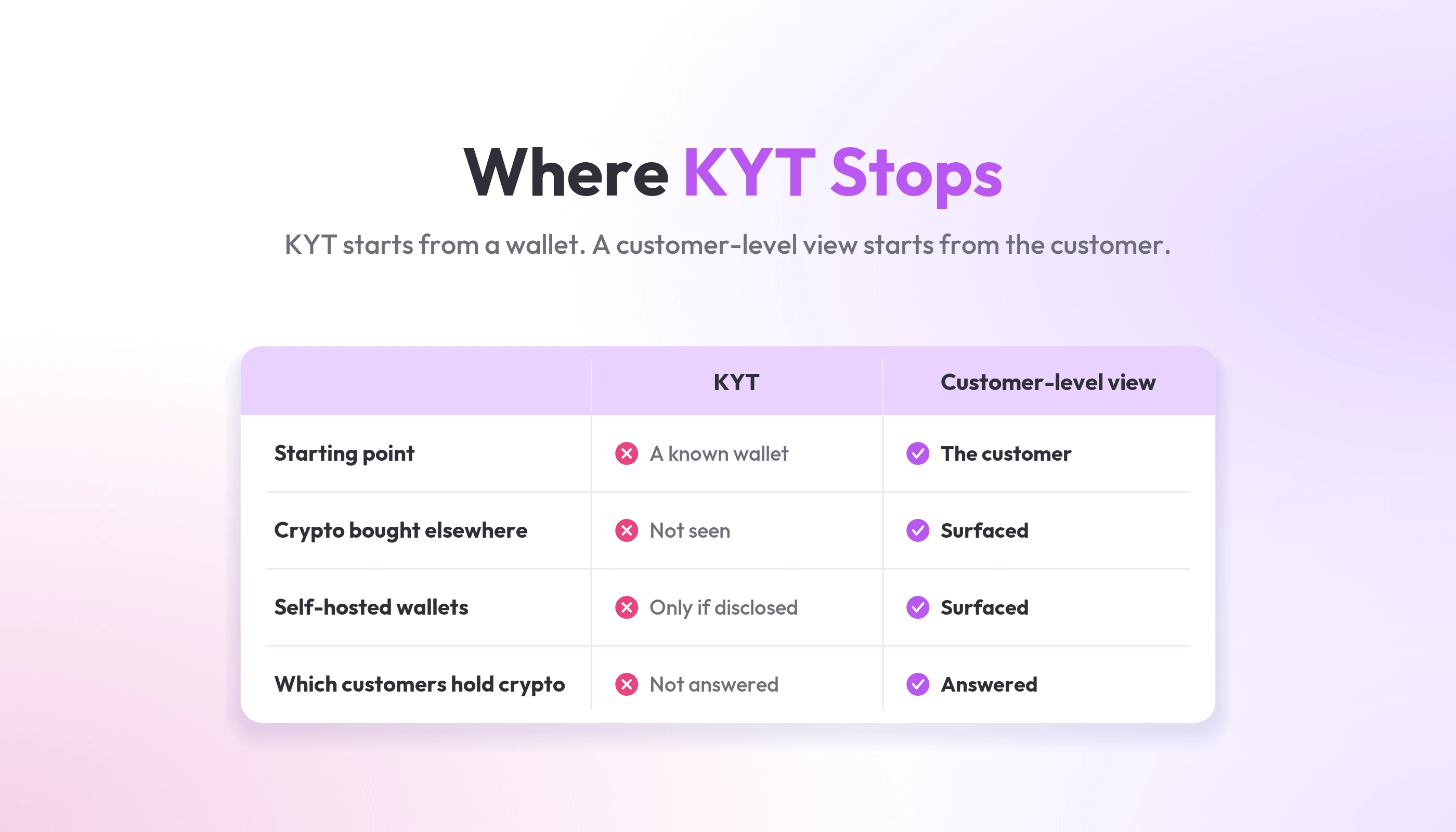
For a crypto exchange that is most of the picture. For a bank it is a small part of it. A bank's customer might:
- buy crypto on an exchange with a card or a bank transfer, which the bank sees only as a payment to a merchant;
- hold crypto in a self-hosted wallet the bank has never been told about;
- receive crypto income or gains that later arrive at the bank as an ordinary fiat transfer.
None of these gives a KYT tool a wallet to screen. The bank's KYT coverage can be complete for the transfers it processes and still say nothing about which customers are active in crypto, how much, or with whom.
That gap matters because the questions banks are asked have changed. Supervisors, auditors and boards increasingly want to know the institution's overall crypto exposure across its customer base, not only whether individual transfers were screened. KYT cannot answer that, because it was built to answer something else.
How do you cover customers whose wallets you have never seen?
You start from the customer instead of the wallet. Rather than waiting for a transfer to screen, the institution takes the customers it already knows and asks which of them show crypto activity, then sends the relevant ones into its existing review process.
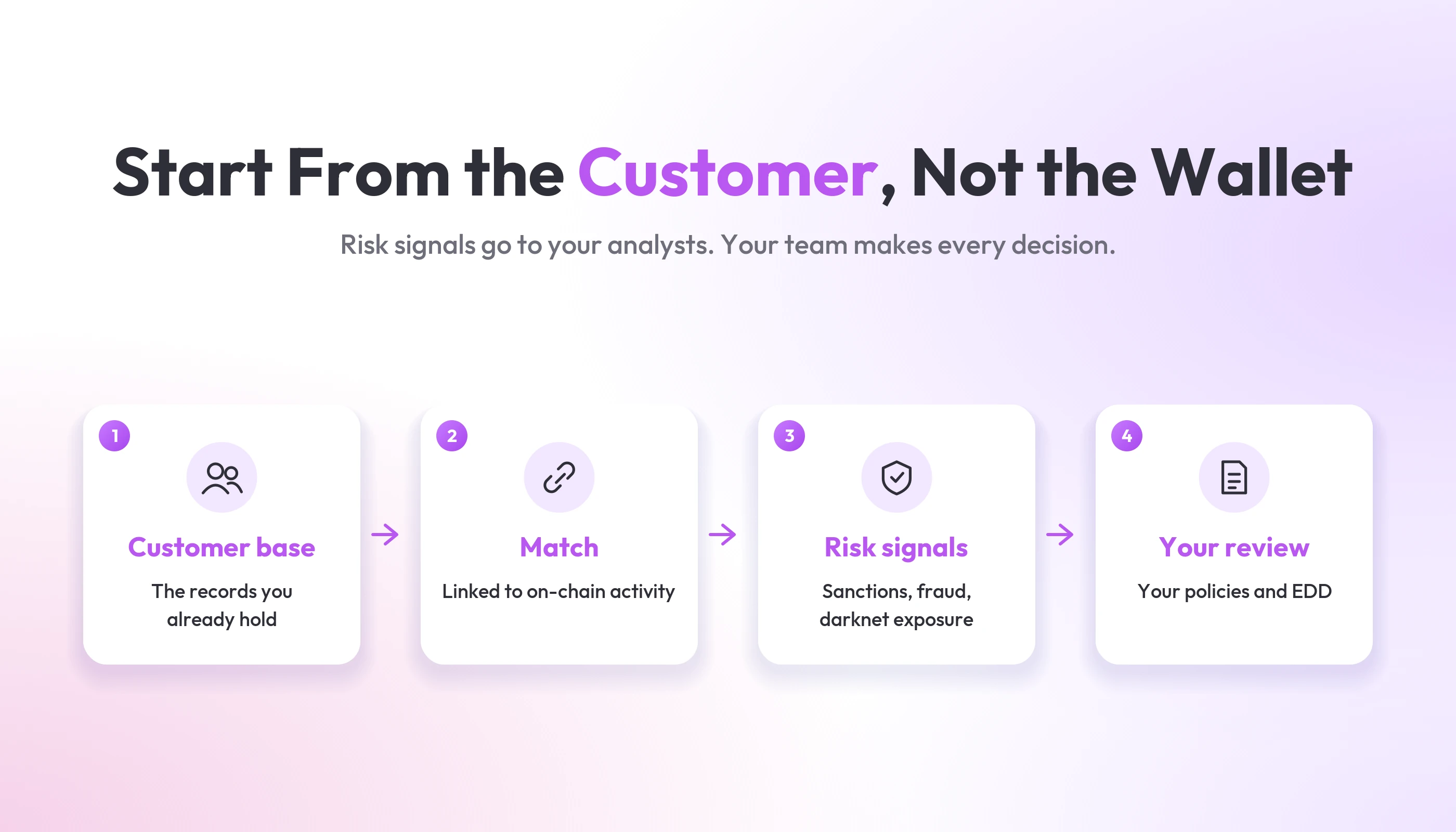
A customer-first approach usually has four steps:
- Start with the customer base. Use the customer records the institution already holds.
- Match to on-chain activity. Link customers to crypto activity through signals the institution does not hold itself.
- Surface risk signals. For matched customers, show exposure to the same risk categories KYT uses: sanctions, fraud, darknet markets and similar.
- Review inside the existing process. The institution's analysts decide what each signal means, using their own policies and enhanced due diligence.
This is where Addressable works. It surfaces crypto risk signals at the customer level, drawing on around 2 billion tracked wallets, so a compliance team can see crypto exposure that KYT never reaches. The institution makes every decision. Addressable does not perform KYC or AML checks, does not decide whether a customer is high risk, and does not file reports.
The simplest way to size the gap is to run the approach on historical data first: take an existing customer base, see how many customers show crypto activity, and compare that with the crypto activity the institution's KYT has actually screened.
FAQ
Is KYT a legal requirement?
KYT is not usually named in law, but the obligations behind it are. Crypto service providers must apply risk-based monitoring and, in most major markets, travel rule checks to their transfers. Banks must monitor customer activity on a risk basis whatever the asset. KYT is the usual way to meet those duties for crypto transfers. This is not legal advice.
Can a bank run KYT if it does not offer crypto services?
A bank can screen any wallet address it receives, but without crypto services it rarely receives one. Card payments to exchanges and fiat transfers from them carry no wallet data. KYT tools therefore add little for a bank without crypto products, and a customer-level view of crypto exposure becomes the more useful control.
Does KYT replace transaction monitoring?
No. KYT covers the on-chain side of crypto transfers. Transaction monitoring covers the customer's account activity over time, including fiat payments to and from exchanges. Most institutions that handle crypto run both, with KYT alerts feeding into the same case management and review process as their other monitoring alerts.
How often should KYT checks run?
KYT usually runs on every crypto transfer, before or after it settles, and again when a wallet's risk changes. Risk changes when new addresses are added to sanctions lists or linked to known fraud. Many institutions also re-screen historical transfers when lists update, so earlier activity is checked against the latest data.