Brazil's betting ban: where the demand went



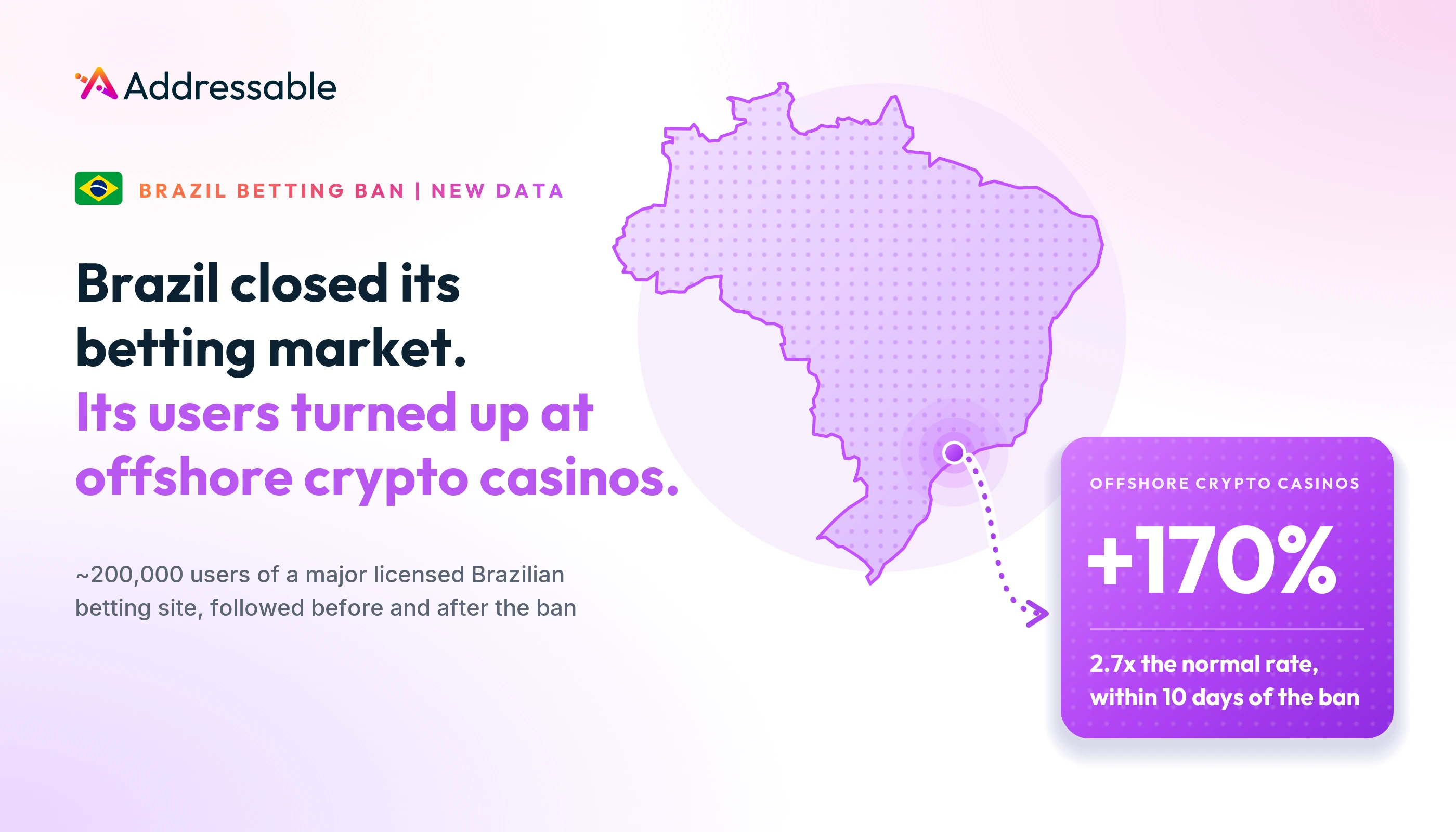
Within 10 days of Brazil announcing its betting ban on 25 September 2026, users of a major licensed Brazilian betting site turned up at offshore crypto casinos at 2.7 times the normal rate, a rise of about 170%. The shift was specific to Brazil and to gambling, and simpler tracking methods saw only part of it.
Those are the headline findings from Addressable's measurement panel, which followed approximately 200,000 users of one licensed site before and after the announcement. This article sets out what the data shows, how it was measured, and what a market shock like this means for growth teams in regulated markets.
What did Brazil's betting ban change?
Brazil's betting ban closed a fully licensed online betting market in under two weeks. Brazil opened a regulated market in January 2025 under Law 14,790. On 25 September 2026, the President signed Provisional Measure No. 1,394, which bans the operation, offering, intermediation and advertising of fixed-odds betting, including by companies based abroad that serve people in Brazil.
The timeline was short:
- 25 September: the measure is signed and new deposits stop immediately.
- 5 October: the last day for users to withdraw their funds.
- 6 October: licensed betting sites go offline.
As of 20 October 2026, the measure is in force but not settled. Congress has up to 120 days to confirm or reject it, the industry association is challenging it in court, and the presidential runoff on 25 October may decide its future. This article is general information, not legal advice.
The ban also landed in a market that was already tightening its rules on crypto. Brazilians declared more than R$500 billion in crypto transactions in 2025, and from 1 October 2026 a new Central Bank rule bars crypto from settling regulated international payments.
Where did Brazil's betting demand go after the ban?
Part of it went to offshore crypto casinos, and it got there within days. In the 10 days after the ban was announced, users of a major licensed Brazilian betting site turned up at offshore crypto casinos at 2.7 times the rate seen before the ban, an increase of about 170%. With 95% statistical confidence, the rate rose between 2.4 and 3 times.
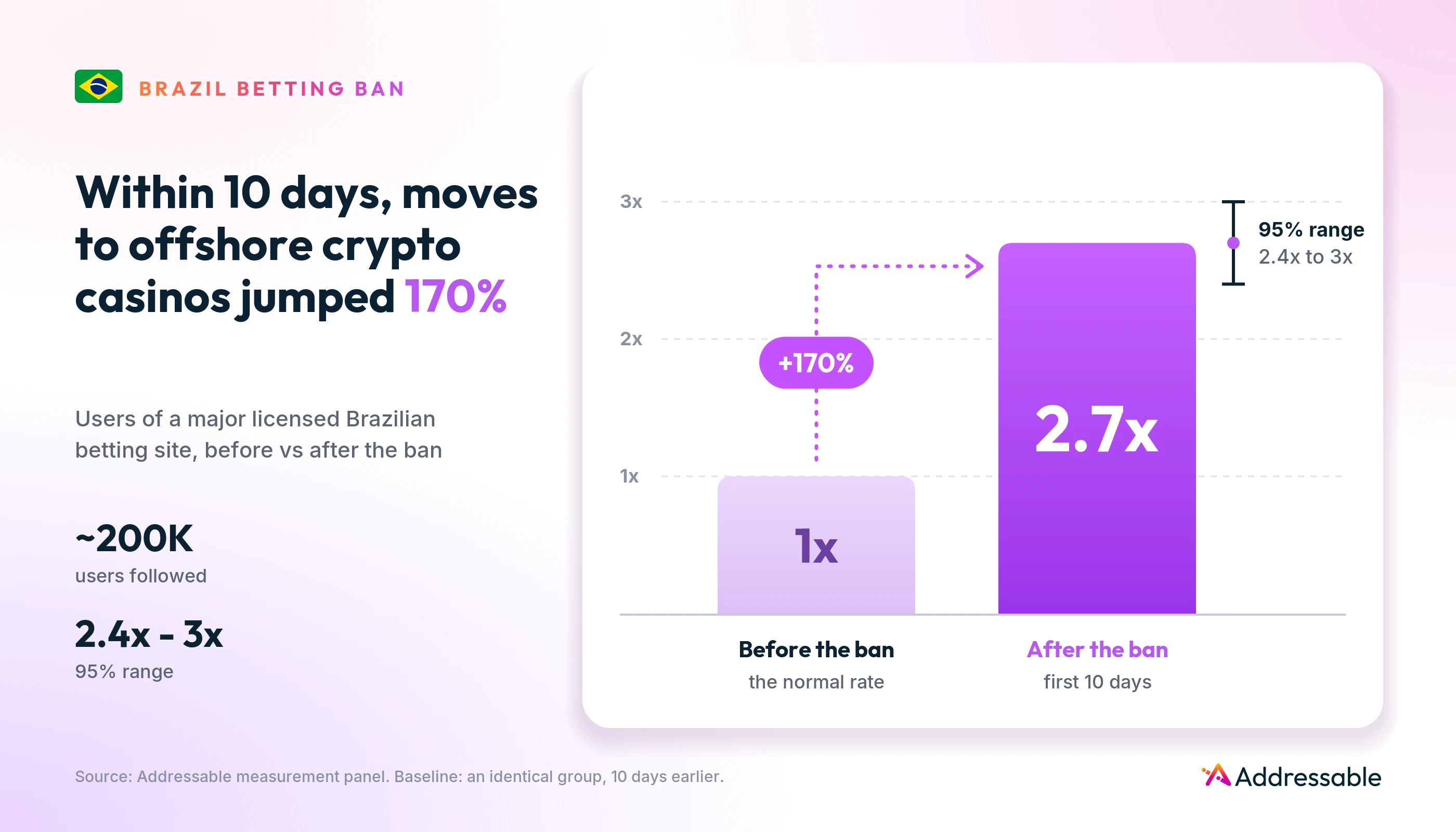
The group was built to make the change easy to read. It contained approximately 200,000 users who had used the licensed site in the month before the ban and had not previously been seen at an offshore crypto casino. So every visit counted after the announcement was a first visit to that kind of site for that user.
The speed matters as much as the size. Users did not drift offshore over a quarter. They found their way there inside the window between the announcement and the day licensed sites went dark.
Was the shift really caused by the ban?
The evidence says the shift was specific to Brazil and to gambling, which is what you would expect if the ban caused it. Addressable tested the two most obvious alternative explanations: normal traffic swings, and a general rise in crypto activity.
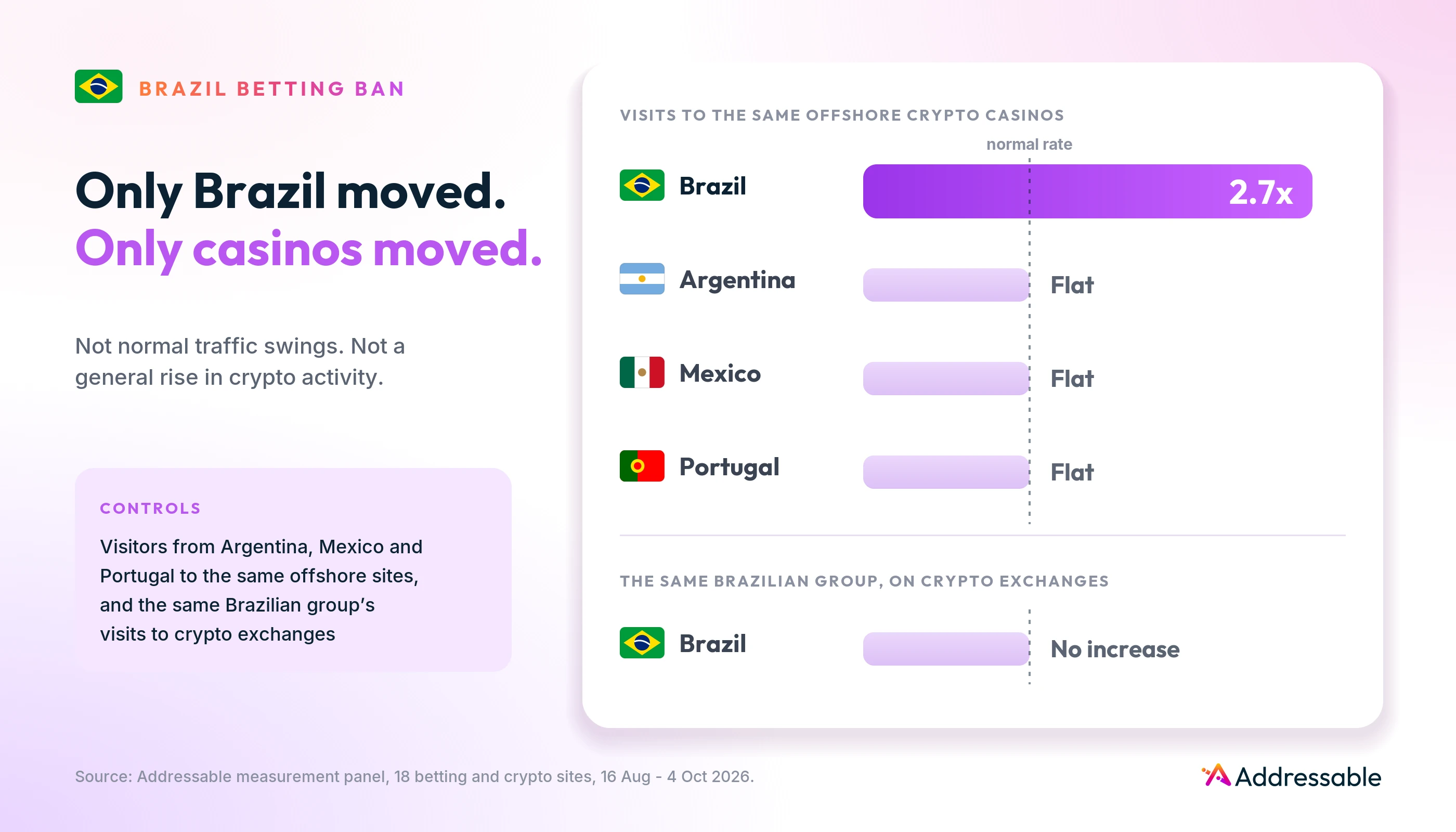
| Comparison | Over the same period |
|---|---|
| Brazilian users of the licensed site, at offshore crypto casinos | 2.7x the normal rate |
| Visitors from Argentina to the same offshore crypto casinos | No comparable change |
| Visitors from Mexico to the same offshore crypto casinos | No comparable change |
| Visitors from Portugal to the same offshore crypto casinos | No comparable change |
| The same Brazilian group, at crypto exchanges | No increase |
If offshore crypto casinos had simply been busier that fortnight, Argentina, Mexico and Portugal would have moved too. They did not. And if Brazilian users had become more active in crypto in general, their visits to exchanges would have risen. They did not either. The change was concentrated in one country and one category.
Why did simpler tracking see a smaller jump?
Simpler tracking saw a smaller jump because it loses users as they move between sites. Measured with browser fingerprints alone, the rate rose 1.8 times. Measured by linking visits from different sites to the same visitor, it rose 2.7 times. The gap between the two is movement that simpler methods miss.
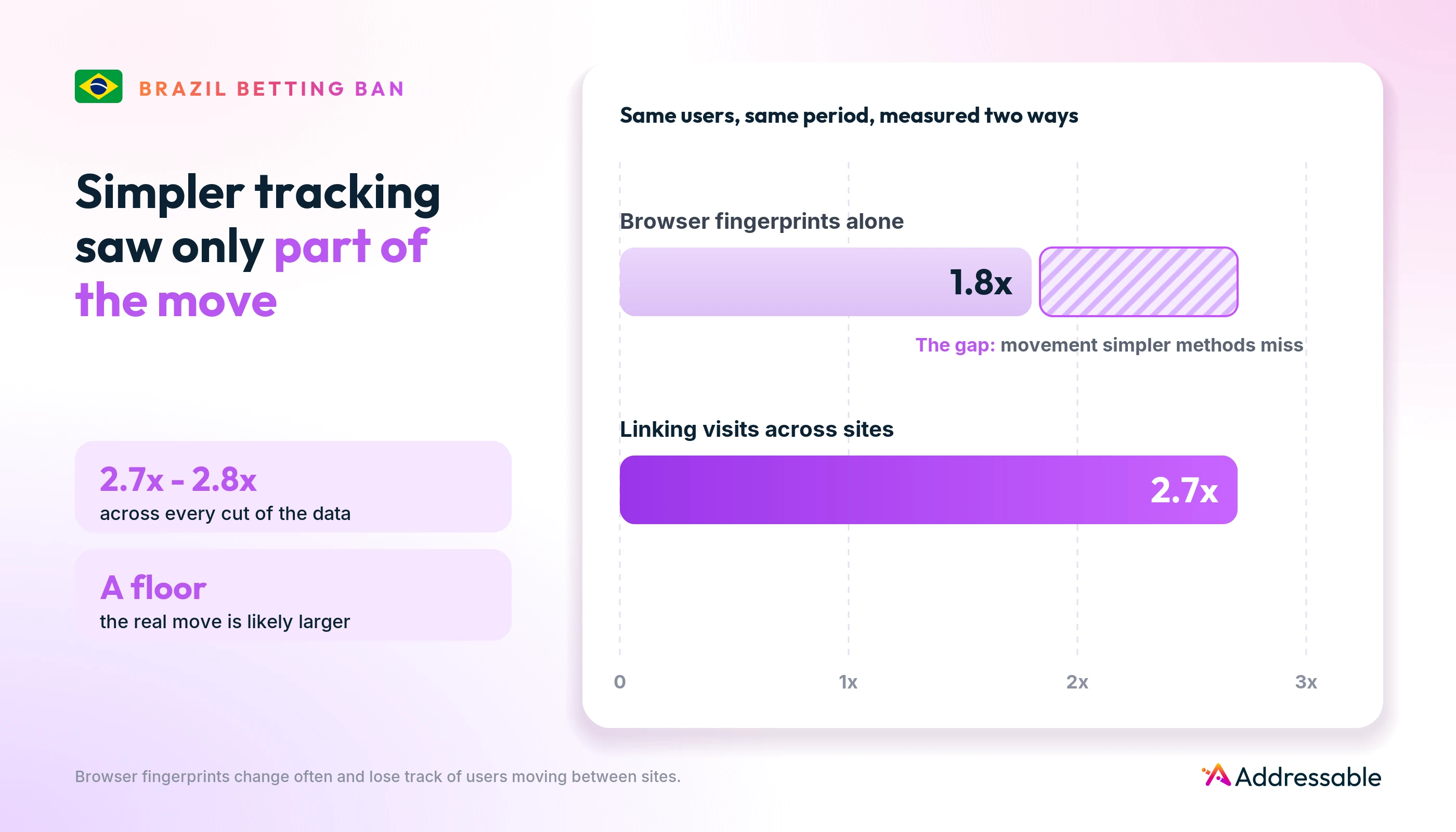
Browser fingerprints change often, so a user who leaves one site and arrives at another can look like two unrelated visitors. Linking several signals together keeps the thread across sites and repeat visits. Across different cuts of the data, the linked result stayed between 2.7 and 2.8 times, so the finding does not depend on one lucky slice.
This is our main lesson from Brazil, and it reaches well beyond betting. When users move between sites, the measurement method decides how much of the movement you see. A method that sees 1.8x where the real figure is 2.7x does not just shrink the number. It changes the story a team tells itself about how much demand moved and how fast.
Why is 2.7x likely a floor?
The 2.7x figure is likely a floor because the observed sites are only part of the offshore market. No one has full visibility of offshore platforms, so the total number of users who moved cannot be known. What can be measured is the rate: how often users from the same group turned up at the sites in the panel before the ban, compared with after it.
That is why the rate, not a headcount, is the finding. A rate measured on part of the market is a reliable signal of direction and speed. The number of users who moved is likely larger than what the panel captures, because some of them went to sites the panel does not observe.
What does a market shock like this mean for growth teams?
A market shock reshuffles where users show up, faster than most reporting can follow. Three lessons from Brazil apply to any growth team, in any market where it is licensed to operate.
- Demand moves in days, not quarters. Monthly dashboards would have shown Brazil's shift after it was over. When a market opens, closes or changes its rules, the first two weeks are when users decide where to go next.
- Single-signal measurement undercounts movement. If attribution relies on browser fingerprints or cookies alone, users who move between sites look like strangers, and the size of a shift is understated. Brazil's gap between 1.8x and 2.7x is a measure of how much a team can miss.
- New users are rarely new to the category. A user who arrives after a shock usually has a history somewhere else: other platforms, other sites, on-chain activity. Reading that history on the first visit tells you who is arriving, instead of waiting months for your own data to say it. We explain how in our guide to identifying high-value users before they deposit.
None of this is about reaching users where a market has closed. Brazil bans advertising by foreign operators, and the right response for an operator is to understand the shift and to acquire users only in the markets where it is licensed or allowed to operate.
What questions does Brazil's betting ban leave open?
Brazil's betting ban leaves one question for each outcome, and one for everyone else.
- If the ban stands: how much of Brazil's betting demand stays where regulators can see it?
- If it is reversed: do users who moved offshore come back to the licensed market?
- For every other regulator: when you close the front door, where do your users go?
“Closing a regulated market doesn't end demand. It moves some of it to places that are much harder to see.”
Dr. Asaf Nadler, Co-Founder and COO, Addressable
Either way, Brazil has shown how quickly demand moves when a regulated market closes, and that the answer depends on being able to follow users across sites.
How was the data measured?
The analysis uses Addressable's measurement panel of 18 betting and crypto websites, covering Brazilian desktop traffic from 16 August to 4 October 2026, with bot traffic removed.
- Group: approximately 200,000 users of a major licensed Brazilian betting site in the month before the ban, not previously seen at an offshore crypto casino.
- Baseline: an identical group built 10 days earlier and followed over the 10 days before the ban.
- Comparison: the rate at which each group turned up at offshore crypto casinos, with a 95% confidence range.
- Controls: visitors from Argentina, Mexico and Portugal to the same sites, and the Brazilian group's visits to crypto exchanges.
- Linking: visits from different sites are linked to the same visitor. A browser-fingerprint-only version was run for comparison.
- Privacy: results are reported in aggregate, and no individual is identified.
FAQ
Is online betting still banned in Brazil?
As of 20 October 2026, yes. Provisional Measure No. 1,394 has been in force since 25 September and licensed sites went offline on 6 October. The measure is not final: Congress has up to 120 days to confirm or reject it, and it is being challenged in court. This is general information, not legal advice.
What happens to the ban after the 25 October runoff?
No one knows yet. The opposition candidate who led the first round has called the ban electioneering, and the runoff on 25 October may decide its future. Either way, Congress still has to confirm or reject the measure within 120 days, so the rules could change again before the end of the year.
Did Brazilian users move into crypto in general?
No. The same Brazilian group showed no increase in visits to cryptocurrency exchanges over the period, so the change was not users becoming more active in crypto overall. The rise was specific to offshore crypto casinos, which points to gambling demand moving rather than a broader shift in crypto interest.
Does this data identify individual users?
No. The results are reported in aggregate, and no individual is identified. The analysis compares how often a group of roughly 200,000 users turned up at offshore crypto casinos before and after the ban, against an identical group built 10 days earlier. The finding is a rate for the group, not a list of users.