Veni, vidi, non vici: Italy is the province crypto casinos haven't conquered



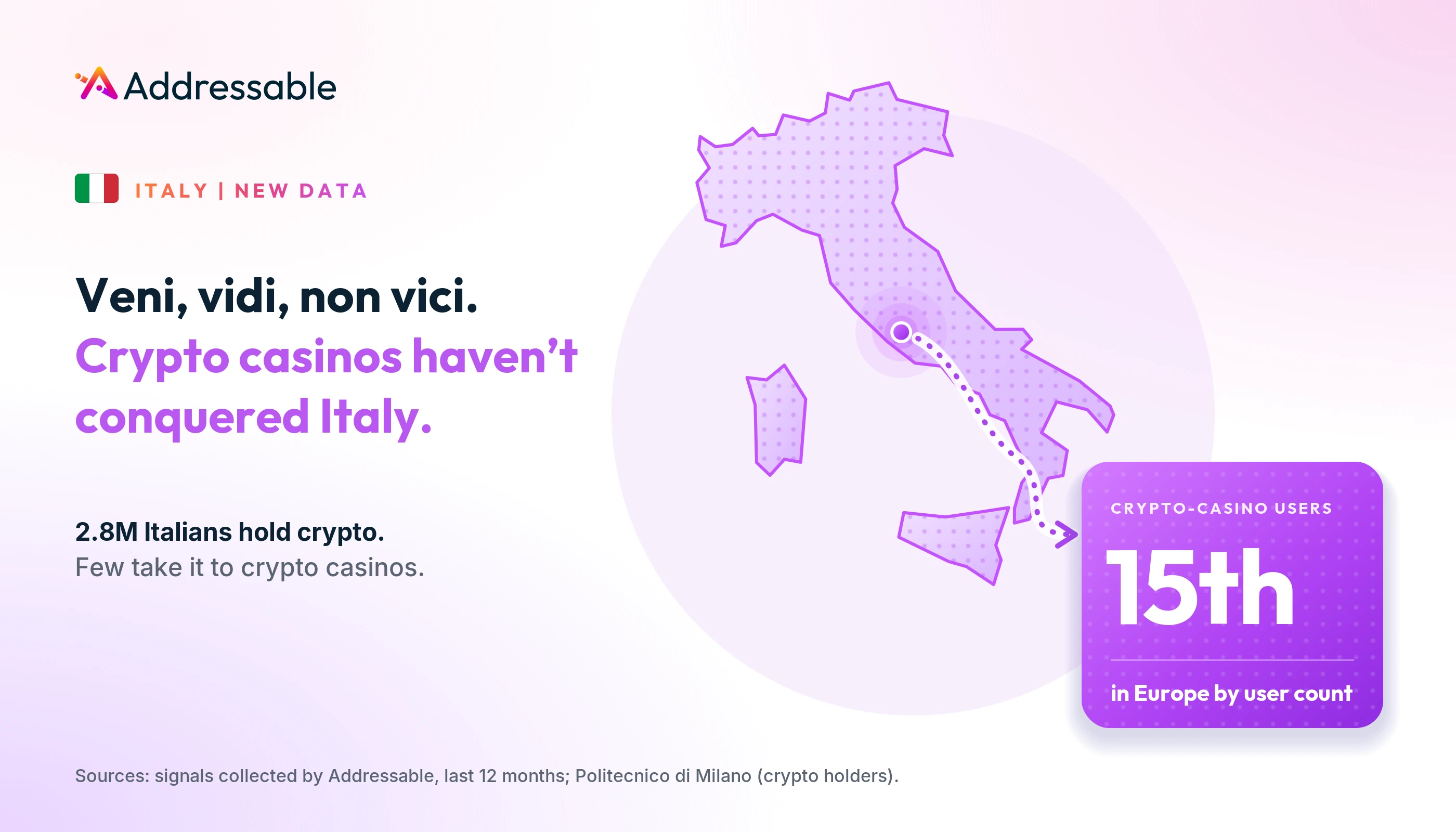
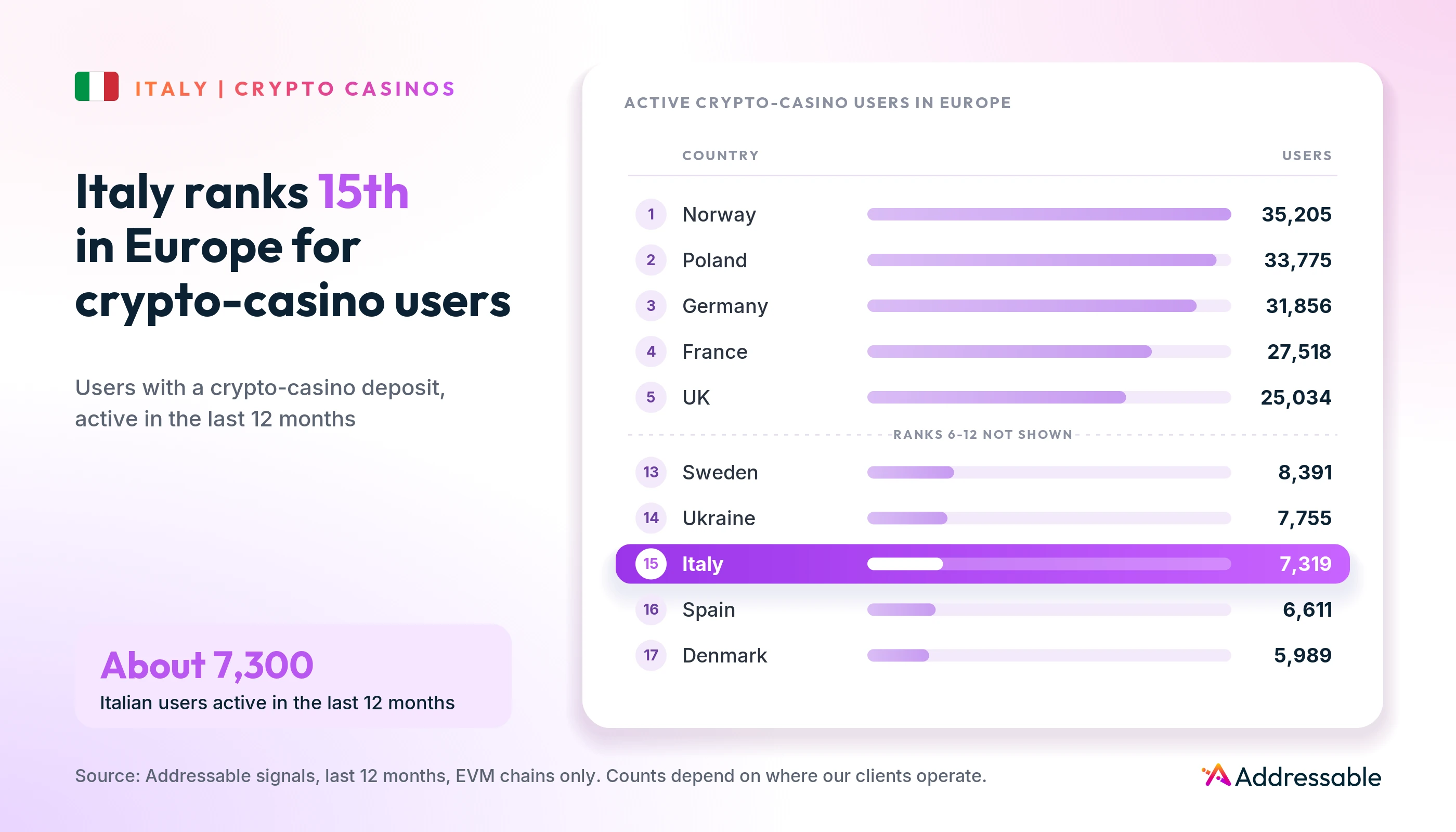
Italy is one of Europe's largest regulated gambling markets and has about 2.8 million crypto holders, yet it ranks 15th in Europe for crypto-casino users. Our signals counted about 7,300 Italian crypto-casino users active in the last 12 months, and just 2.1% of Italian crypto wallets have reached a crypto casino, against 5.4% in Norway.
Everyone heads to Rome for SiGMA because everyone wants Italy. The data says crypto casinos haven't taken it yet. This article sets out where Italy ranks, who the Italian crypto-casino user is, how the numbers were measured, and what we think explains the pattern.
Where does Italy rank for crypto casinos in Europe?
Italy ranks 15th in Europe for crypto-casino users, with about 7,300 active in the last 12 months. Norway, Poland, Germany, France and the UK lead the ranking. Among the seven large regulated markets in Europe, Italy comes last once population is taken into account.
The clearest way to compare countries is propensity: the share of a country's crypto wallets that have reached a crypto casino. It removes the size of each country's crypto population from the comparison.
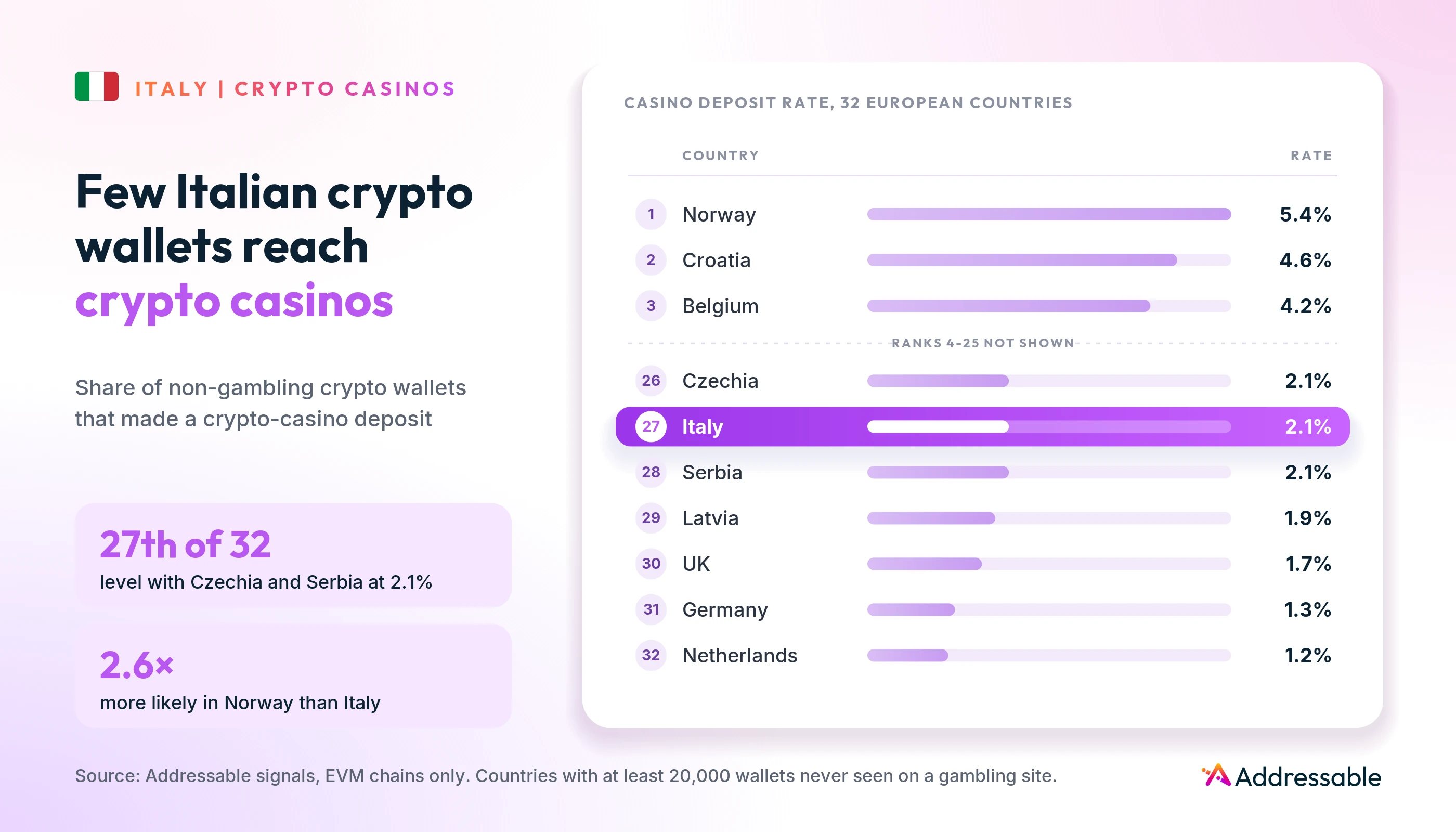
A crypto wallet in Norway is about 2.6 times as likely to have reached a crypto casino as one in Italy. That gap is not explained by a lack of crypto, or of gambling, in Italy. Italy is one of Europe's most valuable online gambling markets, and an estimated 2.8 million Italians, about 7% of consumers, hold crypto-assets, according to the Politecnico di Milano's Blockchain & Web3 Observatory. Italians have crypto. Few of them take it to crypto casinos.
Who is the Italian crypto-casino user?
The Italian crypto-casino user is more crypto-native than the European average, plays for smaller stakes, churns faster and is concentrated in two regions. About 1 in 50 Italian crypto wallets seen outside gambling sites has deposited at a crypto casino, which implies at least 50,000 to 60,000 Italians.
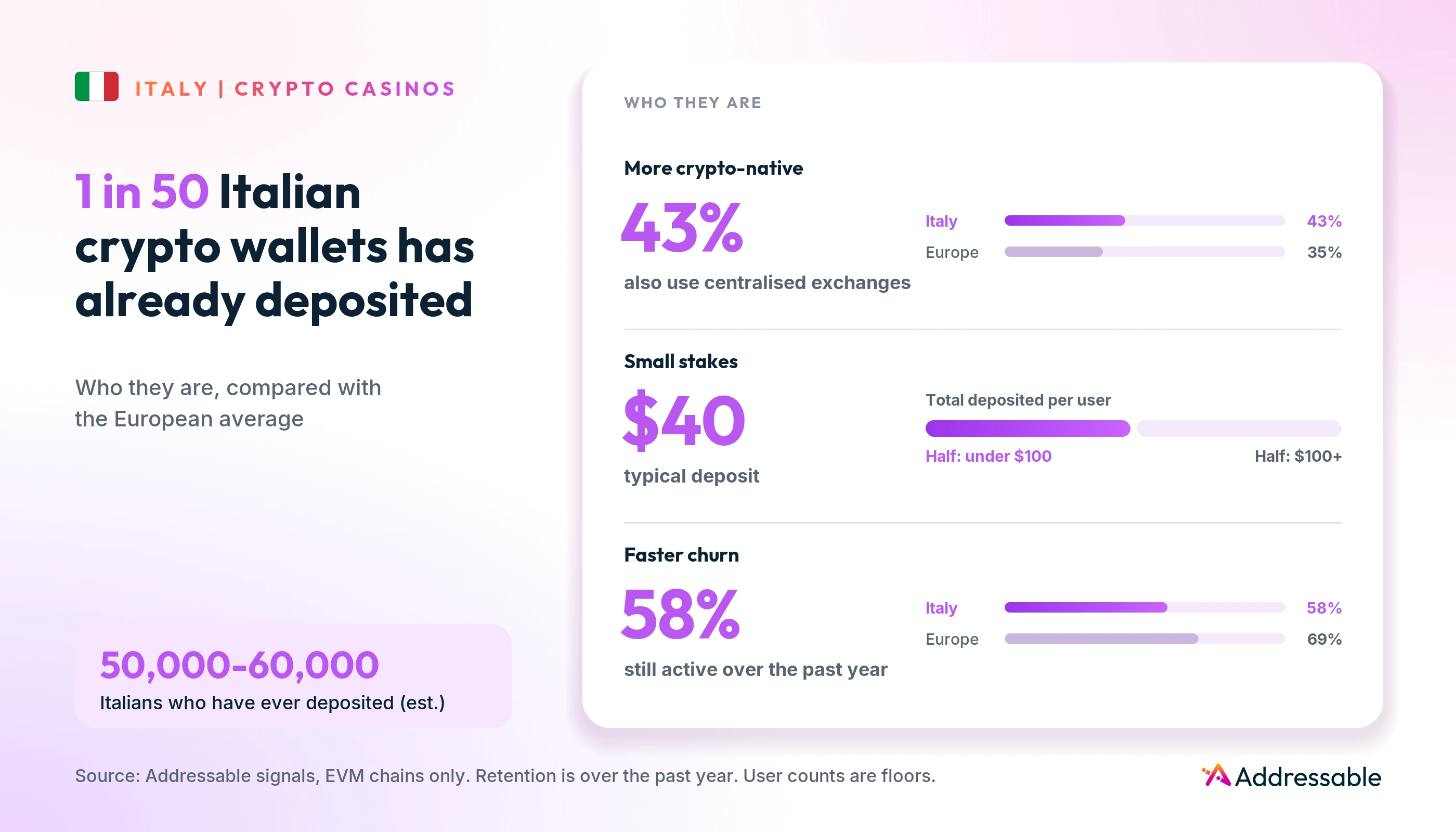
- More crypto-native: 43% also use centralised exchanges, against a European average of 35%.
- Smaller stakes: half have deposited less than $100 in total, and a typical deposit is about $40.
- Faster churn: 58% stayed active over the past year, against 69% across Europe.
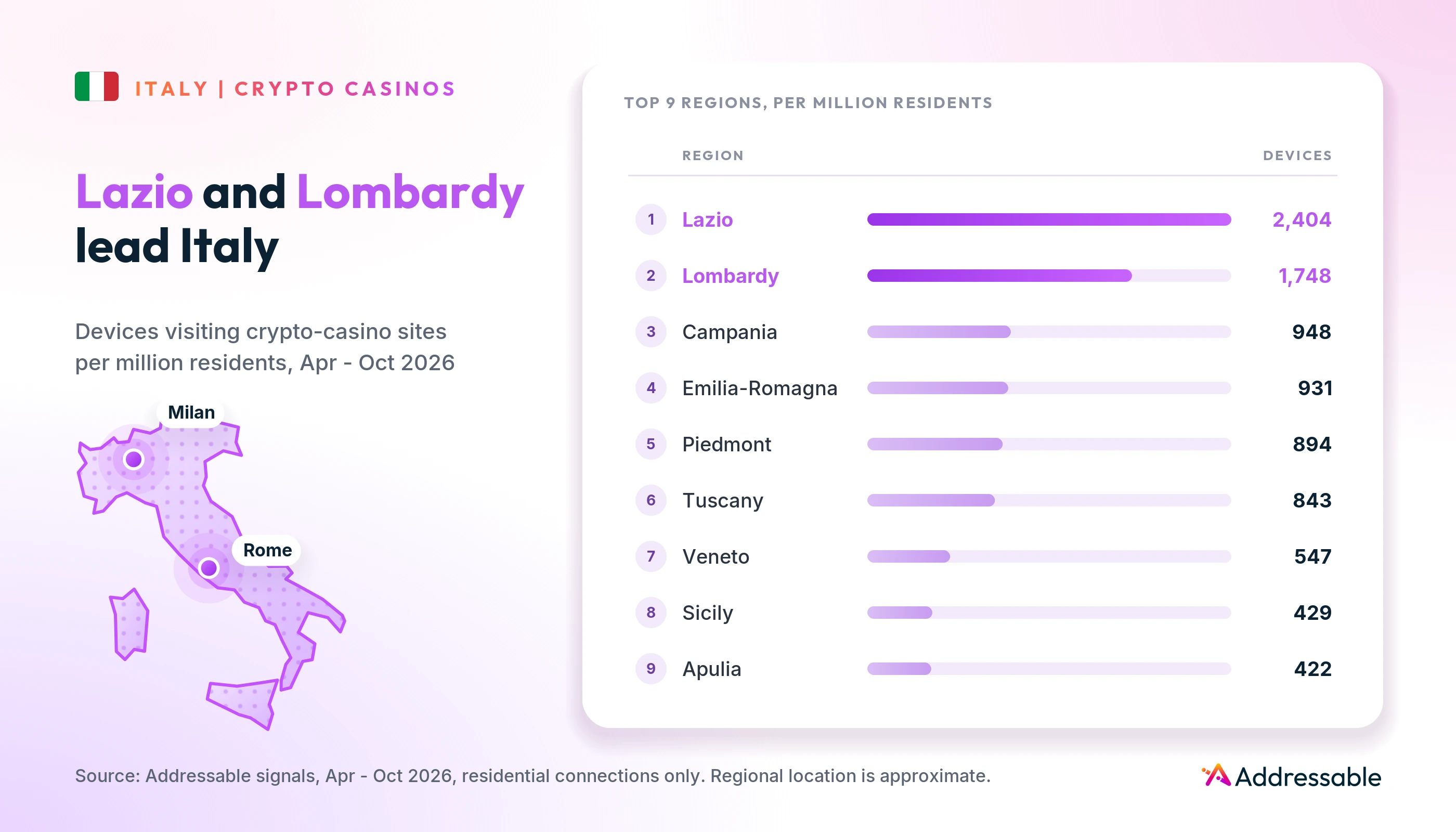
- Regions: Lazio and Lombardy, the regions of Rome and Milan, lead the country for devices visiting crypto-casino sites per resident.
This is a real audience, but not a large or a high-spending one. It looks like crypto users who try a crypto casino, rather than gamblers who moved to crypto. That distinction matters for anyone sizing the market.
Did Italy's licensing reform change anything?
No. The number of Italian wallets depositing at crypto casinos each month has not grown since early 2025, and it did not move in either direction after the reform. Italy's new online licensing regime under Legislative Decree 41/2024 replaced the old concessions in November 2025 with nine-year licences at €7 million each.
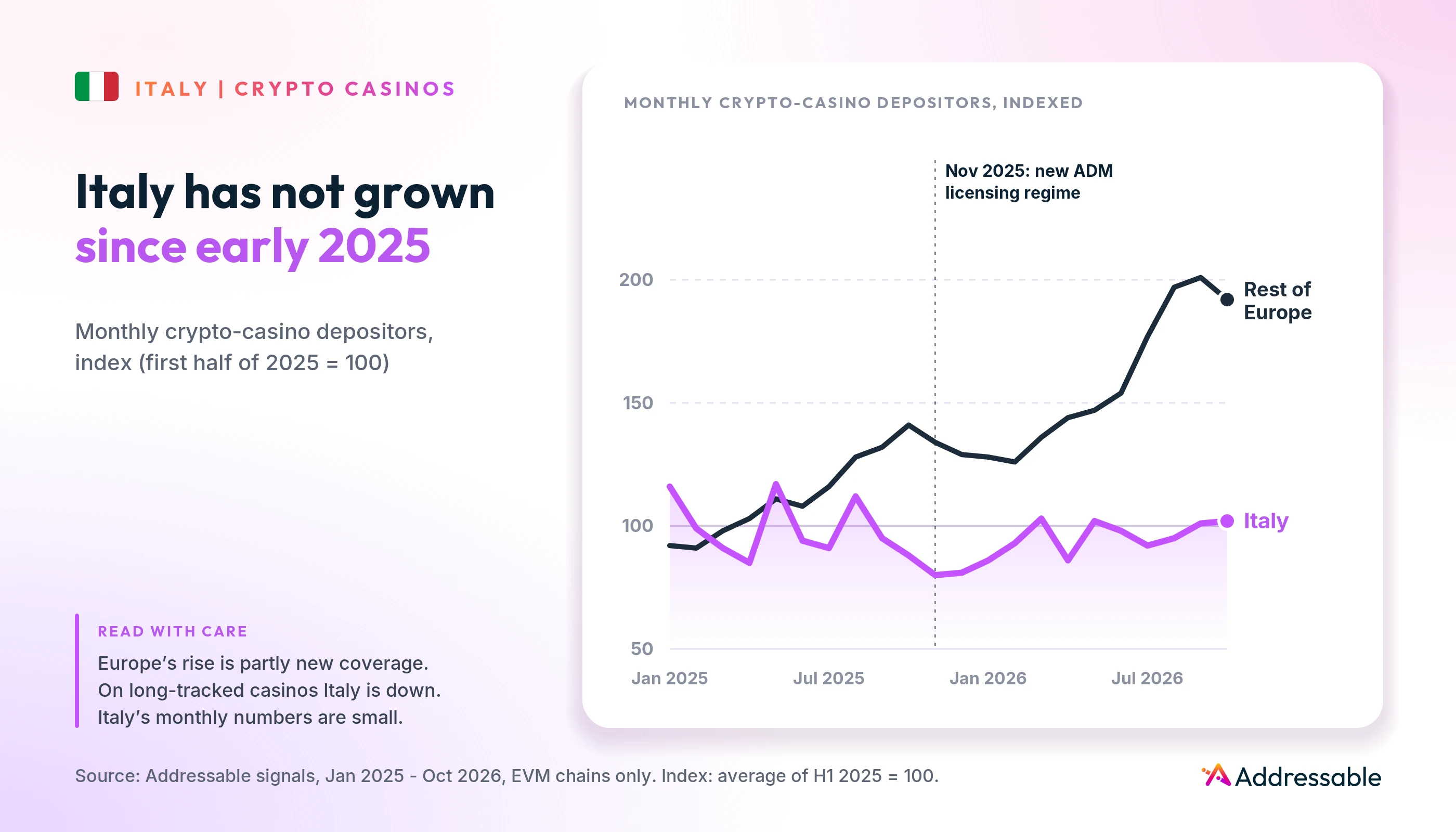
Over the same period the total for the rest of Europe rose, but part of that rise reflects casinos that joined our signals in 2026. On a fixed set of long-tracked casinos, Europe is flat and Italy is down. Italy's monthly numbers are small, so the line is noisy. The reform reshaped the licensed market. It did not change how often Italians reach crypto casinos.
Why hasn't crypto gambling taken off in Italy?
Our interpretation is that Italy's licensed market keeps demand onshore. The data shows the pattern, but it does not prove the cause, so we offer this as a reading of the evidence rather than a finding.
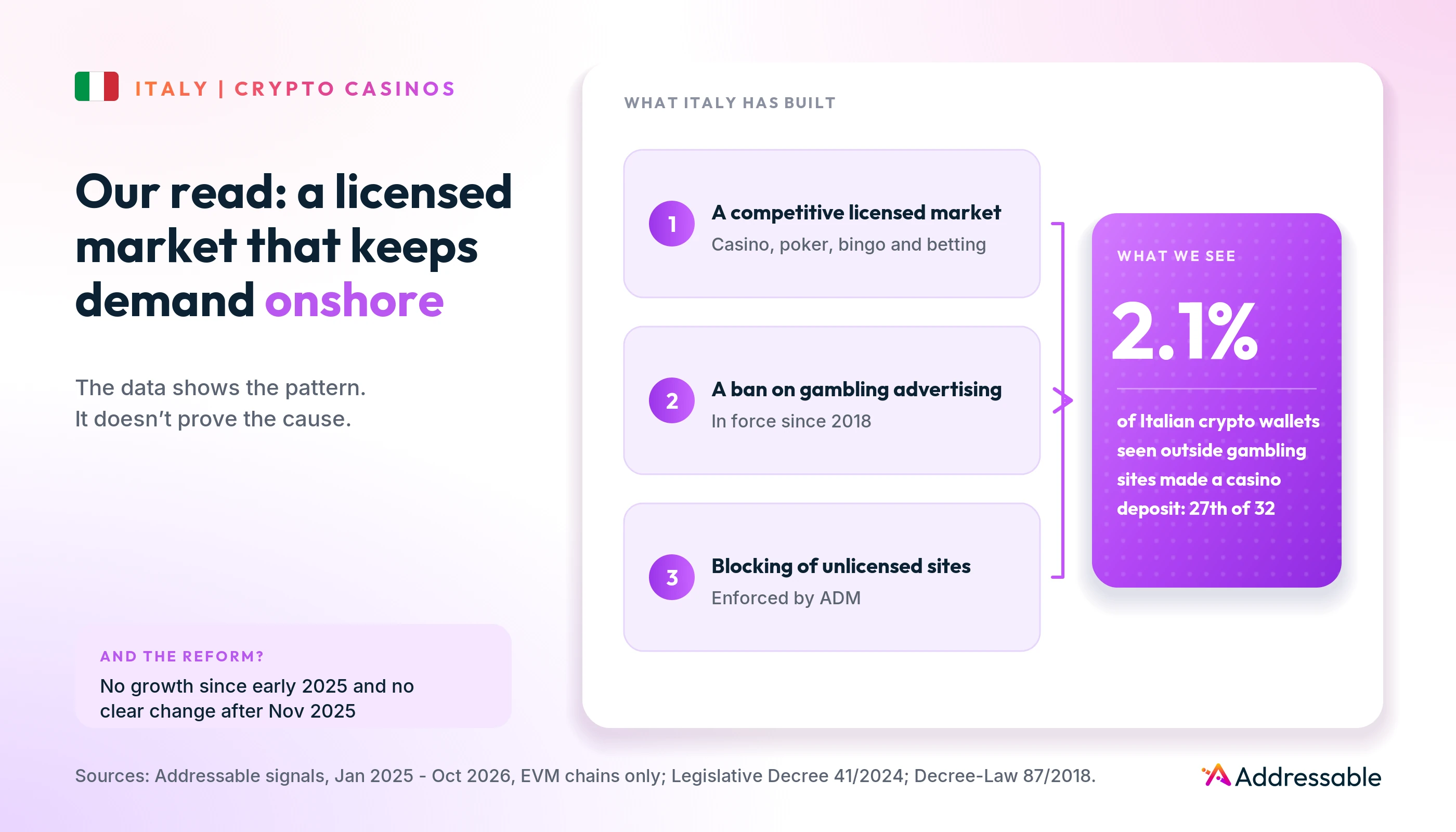
Across Europe, crypto-casino use tends to be higher where online casino is a monopoly or heavily restricted, and users who cannot find what they want in the licensed market look elsewhere. Italy is the opposite case. It has built a broad, competitive licensed market, it has banned gambling advertising since the 2018 Dignity Decree, and its regulator, ADM, blocks access to unlicensed gambling sites.
What does this mean for growth teams?
Italy shows that crypto adoption and crypto gambling are different things, and that the licensed offer in a market shapes where crypto users end up. Three lessons apply to growth teams in any market where they are licensed to operate.
- Look at propensity, not just volume. Raw counts favour big markets and markets where data coverage is strong. The share of crypto users who actually reach a category is a fairer way to compare countries and to size an opportunity.
- Small stakes and fast churn change the maths. An audience that deposits $40 at a time and churns faster than average needs a different acquisition budget and a stronger retention plan than the headline numbers suggest.
- Know who is arriving from the first visit. A user's on-chain history shows whether they are crypto-native, how active they are and where else they spend, before they register. We explain how in our guide to identifying high-value users before they deposit.
None of this is about reaching Italian users without an Italian licence. Italy bans gambling advertising and blocks unlicensed sites, and the right response for an operator is to understand the market and acquire users only where it is licensed or allowed to operate.
How was the data measured?
The analysis uses signals collected by Addressable covering the last 12 months, with bots, test and internal traffic excluded.
- Two independent paths: country from our signals, and on-chain activity only. Italy's rank holds on both.
- Counts: counts are distinct profiles in our signals, not confirmed individuals, and cover EVM chains only. Every count is a floor.
- Propensity: the share of a country's crypto wallets, seen outside gambling sites, that have reached a crypto casino.
- Comparisons: country comparisons use propensity rather than per-capita counts, because coverage differs between countries.
- Trend: monthly wallets depositing at crypto casinos, January 2025 to October 2026, indexed to the first half of 2025.
- Regions: residential devices visiting crypto-casino sites per million residents, April to October 2026. Regional location is approximate.
- Privacy: results are reported in aggregate. No individual and no casino is identified.
About the author. Dr. Asaf Nadler is Co-Founder and COO of Addressable. He holds a PhD and has published research on blockchain data analytics, and he has a long-standing interest in how users are acquired and where they move. He previously introduced Cost Per Wallet, a metric for crypto user acquisition, and analysed where Brazilian betting demand went after the ban.